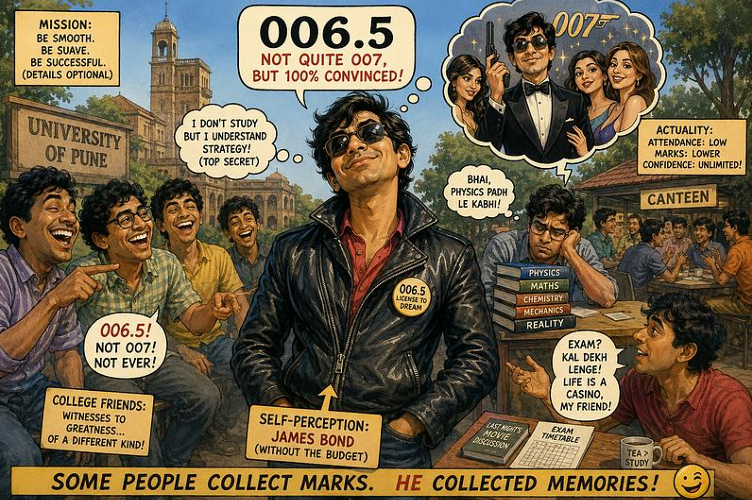
Bond. James Bond. Not Quite.
Author: Dr. Anirban Sadhu
The University of Pune in those days was one of the finest public universities in India and attracted students from every corner of the country. There were boys and girls from metropolitan cities and from remote villages, from missionary schools and government schools, from wealthy families and modest households. Some came with a single-minded determination to excel academically. These were the people who seemed to possess a permanent relationship with textbooks and libraries. Others came to enjoy what was then, for most of us, our first real taste of independence. They attended classes when absolutely necessary and devoted the rest of their energy to friendships, conversations, movies, tea stalls, cricket matches, and romantic adventures of varying success. Most of us occupied a middle ground somewhere between these two extremes. We wanted good grades, certainly, but we were equally interested in everything else that university life had to offer.
It was also a fascinating social moment in India. For many of us, this was the first time we found ourselves living and studying alongside large numbers of young women outside the supervision of parents, schools, priests, monks, teachers, or assorted guardians of morality. Curiosity flowed freely in both directions. Boys suddenly discovered an interest in literature they had never previously displayed if the right girl happened to recommend the book. Girls occasionally discovered an interest in cricket that coincided suspiciously with the presence of particular boys. Entire romances were built upon the flimsiest foundations imaginable. Looking back, it was all wonderfully innocent and endlessly entertaining.
Among this diverse population there existed every imaginable human type. We had our future scientists, future bureaucrats, future entrepreneurs, future professors, and future disappointments. We had one fellow who was so determined to become a romantic hero that he wore a leather jacket throughout the year. It did not matter whether Pune was experiencing summer, monsoon, or autumn. The jacket remained. He had seen a popular Hindi film in which the hero wore a leather jacket and had concluded that the fabric was the principal requirement for romantic success. The fact that the garment looked entirely natural on the actor but faintly ridiculous on him never seemed to occur to him. Such was the power of cinema in those days.The jacket looked magnificent on the actor. On our friend it looked like an unfortunate administrative error.
Yet he persisted
Yet even he was overshadowed by a far more remarkable character.
His real name has largely disappeared from memory. If somebody reminded me of it today, Imight vaguely recognize it, but that is not how any of us remember him. He survives in our collective memory under a far more appropriate title: 006.5.
The nickname requires some explanation. Those who grew up in the era of James Bond will immediately understand the reference. Bond was the ultimate fantasy figure of the late twentieth century: impossibly smooth, impossibly confident, effortlessly charming, admired by women, feared by villains, and apparently capable of succeeding at anything without breaking a sweat.Bond entered every room as though he owned it and exited every crisis with perfect hair a nd anattractive companion. To young men of that era, he represented a standard of coolness that bordered on the supernatural. Bond was 007.
Our friend admired this model intensely.
In fact, admired may be too weak a word. He appeared to believe that he was James Bond. 007!
The joke was not that he was incompetent. The joke was that he genuinely believed he was James Bond. Not merely successful. Not merely confident. Smooth. Suave. Irresistible. A master strategist. A man to whom life would naturally surrender its treasures. The rest of the world, meanwhile, had reached a different conclusion.
He did not carry a Walther PPK or work for British intelligence. In fact, intelligence is not a word that we associate with him. But in his own mind he possessed all the essential qualities. He considered himself sophisticated, charming, strategic, and destined for success. Unfortunately, reality had reached a different assessment. The gap between his self-perception and his actual circumstances was so large that it could probably have been measured from space.
Thus was born the name 006.5. Not quite 007. Almost, but not really.
Close enough to recognize the ambition. Far enough away to acknowledge the facts.
The nickname was perfect because it captured the central mystery of his personality. Unlike most of us, he never seemed aware of any contradiction between his aspirations and his performance.
Academic achievement, for example, occupied a very unusual place in his worldview. Most
students recognized some relationship between studying and examination results. He appeared unconvinced by the evidence. While the rest of us revised notes late into the night, he often behaved as though examinations were administrative inconveniences imposed upon him personally by an unfair universe.
The astonishing thing was that poor results never damaged his confidence. If an examination went badly, he simply carried on exactly as before. If a plan failed, he moved on without visible distress. If people laughed at him, he laughed along with them. It was almost impossible to wound his pride because his pride seemed entirely disconnected from external events.
At the time, we considered this ridiculous.
Today, I am less certain.
The older I become, the more I realize that most adults spend their lives trapped in an endless cycle of comparison. We compare salaries, promotions, houses, investments, children’s achievements, retirement savings, social status, professional recognition, and a hundred other metrics. Success brings temporary satisfaction until somebody else succeeds more. Failure brings disappointment because somebody else appears to be doing better. We are constantly measuring ourselves against the world.
006.5 never measured anything.
This was undoubtedly one reason why he achieved so little.
It may also have been one reason why he seemed so happy.
I remember countless conversations in which he would explain his future plans with breathtaking confidence. The details were usually vague. The strategy was often nonexistent. The probability of success was approximately equal to that of finding a tiger in the university library. Yet his optimism remained untouched. Listening to him was like listening to an inspirational speaker who had accidentally skipped the chapter on practical implementation.
What made him unforgettable, however, was not his lack of achievement. Universities produce thousands of underachievers. Most are forgotten within months. What made 006.5 memorable was the extraordinary consistency with which he remained himself. He never pretended to be somebody else. He never became bitter. He never seemed ashamed of his failures. He moved through life with an almost childlike conviction that things would somehow work out.
Looking back after thirty-five years, I cannot honestly tell you whether he eventually became successful. Perhaps he did. Perhaps he didn’t. Life has scattered our generation across countries, professions, and continents. Many people have disappeared from view. But success is not really the reason we still remember him. We remember him because every group of friends acquires certain legendary characters whose personalities become larger than life. They become part of the folklore of a generation.
Our folklore had many characters, but none more enduring than 006.5.
Today, when old classmates reconnect, nobody remembers examination marks. Nobody remembers who ranked first in a particular semester. Nobody remembers attendance percentages. Yet everyone remembers 006.5. Everyone remembers the supreme confidence, the heroic self belief, the complete immunity to embarrassment, and the magnificent mismatch between aspiration and execution.
Perhaps that is why he remains so vivid in memory. We spent our youth trying desperately to become successful adults. He spent his youth trying to become James Bond. We failed occasionally and worried about it. He failed regularly and laughed about it.
And somewhere in that absurdity lies an uncomfortable possibility: perhaps the rest of us learned achievement more successfully than he did, but perhaps he learned happiness more successfully than the rest of us.
He was never 007. Not even close.
But thirty-five years later, when old friends gather and stories begin to flow, it is not James Bond we talk about.
It is 006.5.